

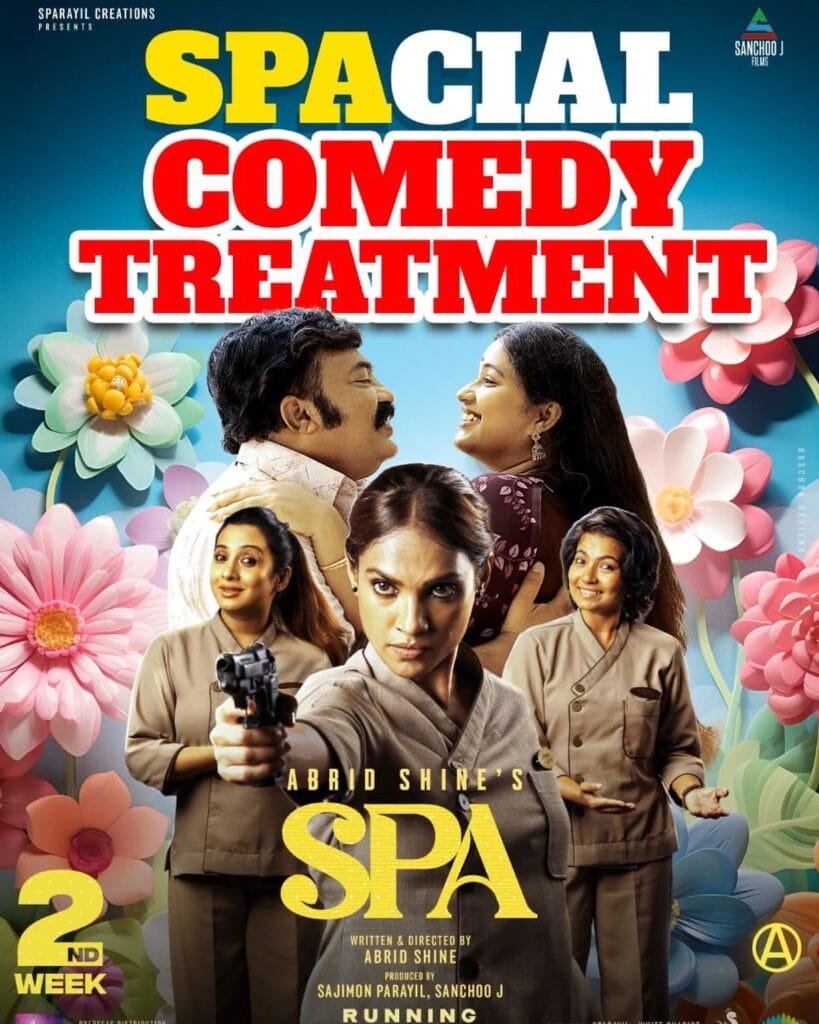
In his latest cinematic experiment, Spa, director Abrid Shine opens with a meta-moment: a filmmaker (Sidharth Bharathan) tries to coax a therapist into sharing her “traumatic” past to fit a classic three-act movie structure. Her simple rebuttal—asking why a story needs conflict—serves as the manifesto for the film itself. Set within a massage center in Kochi, Spa is an episodic, satirical look at the lives of therapists and the diverse men who visit them. It abandons traditional storytelling to hold a mirror to society’s double standards regarding desire and “culture.”

Acting
The film’s strength lies in its ensemble. Shruthy Menon shines as the seasoned, confident leader of the therapists, portraying professional grace without a hint of the “victim” cliché. Radhika Radhakrishnan and Sreeja Das provide authentic, grounded performances that keep the spa’s environment feeling real. On the flip side, the male cast steals many of the comedic moments by playing against type. Vineeth Thattil is standout as Mathan (or “Pookie Mathan”), a rugged man whose vulnerability and awkward attempts at romance are both hilarious and touching. Dinesh Prabhakar as a poet with odd kinks and Rahul Madhav as a narcissistic actor provide sharp comedic relief, while veterans like Srikanth Murali and Major Ravi successfully subvert their usual “serious” screen personas.

Direction
Abrid Shine continues his streak of breaking cinematic rules, much like he did in Action Hero Biju and Poomaram. His direction is observational rather than preachy. He avoids the “fallen woman” trope, instead presenting the therapists as working professionals who don’t feel the need to justify their choices. While his attempt to dismantle traditional structure is brave and mostly engaging, the direction falters in the final act. The sudden shift into an underdeveloped, action-heavy subplot feels disconnected from the quiet, observational humor of the rest of the film.

Technical Aspects
Visually, the film makes a powerful statement by what it chooses not to show. Despite the setting, the camera refuses to objectify the female body. Instead of focusing on nudity or “jiggling” tropes often found in adult-rated cinema, the cinematography focuses on the behavior and expressions of the men. It captures their vulnerability and the stripping away of their social masks. The setting of the spa is used effectively as a claustrophobic yet intimate stage where the “linear and simple” storytelling unfolds.
Music
The film relies more on its rhythmic, episodic dialogue and atmospheric sounds than a heavy background score. The auditory experience complements the “fly on the wall” feel of the movie, allowing the humor in the conversations to take center stage. However, the tonal shift in the climax brings a change in energy that feels slightly forced compared to the organic flow of the earlier segments.
Overall
Spa is a daring and funny experiment that mocks social hypocrisy with ease. While the ending doesn’t quite land, it remains a refreshing watch for its bold refusal to follow the rules of “moral” filmmaking.